
India’s Road to the ICC Men’s T20 World Cup 2026: Conditions, Strategy & Key Challenges
As defending champions, India enter the ICC Men’s T20 World Cup 2026 under immense expectations. Co-hosted by India and Sri Lanka, the tournament will be played largely in familiar subcontinental conditions, but familiarity does not guarantee success. With matches spread across venues offering contrasting pitches and dimensions, India’s campaign will hinge on adaptability, tactical clarity, and execution under pressure.
Group Stage: Comfortable on Paper, Dangerous in Reality
India are grouped with USA, Namibia, and the Netherlands. On paper and historically, India are far superior, which is why these matches may appear straightforward. However, T20 cricket remains unpredictable, on any given day, a single inspired performance can change the result. That said, given the relative strength gap, these fixtures are unlikely to define India’s campaign, and a deeper tactical breakdown is unnecessary here.
The First Real Test: India vs Pakistan
Date: 16 February
Venue: R. Premadasa Stadium, Colombo, Sri Lanka
This match marks the true beginning of India’s high-pressure World Cup journey. Beyond cricketing rivalry, recent political tensions and on-field actions by players have added emotional fuel to the contest. The battle will not be limited to the ground; it will echo across 1.4 billion Indians and nearly 250 million Pakistanis worldwide.
R. Premadasa Stadium – T20 Data
Total T20 matches: 47
Wins batting second: 27
Wins batting first: 19
Average first-innings score: 142–149
Highest successful chase: 214
Pitch Behaviour
Slow, dry surface
Low bounce
Significant assistance for spinners
Minimal help for fast bowlers beyond the powerplay
Even in night games, dew does not fully neutralize spin, and the middle overs are traditionally spinner-dominated.
Challenge for India
Against Pakistan’s pace-heavy attack, Indian batters must avoid reckless shot-making. Strike rotation, sweeps, and controlled aggression will be crucial. If India win the powerplay battle, nearly 90% of the job is done. With the ball, Indian spinners will be expected to suffocate Pakistan’s middle order.
Tactical Takeaways
Chasing teams have a slight advantage, but totals above 200 are still achievable
Disciplined bowling can restrict scoring
Well-paced chases often succeed
Advantage: Spinners
Ideal Strategy: Dominate middle overs through spin
Possible Combination: Varun Chakravarthy, Kuldeep Yadav, Axar Patel
Players to Watch: Varun, Kuldeep, Tilak Varma
Beyond the Group Stage: The Real Battle Begins
Once the group stage concludes, India face elite opposition — Australia, South Africa, New Zealand, and England.
India’s Super 8 and knockout matches will be played across:
Delhi
Mumbai
Ahmedabad
Kolkata
Chennai
Each venue presents a distinct tactical challenge.
Arun Jaitley Stadium, Delhi
Pitch Behaviour
Red-soil surface
Good for batting initially
Spinners become effective later
Cutters and slower balls work well
Competitive scores: 170–180
T20 Data
Batting first wins: 4
Batting second wins: 4
Highest total: 221/9
Highest chase: 212/3 (South Africa vs India)
Delhi shows no clear bias toward batting or chasing — execution matters more than the toss.
Challenge: Controlling middle overs
Key Insight: Flat, quick spin is more effective due to short boundaries
Advantage: Balanced, slightly batting-friendly
Ideal Strategy: Bat deep, bowl with variations
Players to Watch: Axar Patel, Arshdeep Singh, Abhishek Sharma
Wankhede Stadium, Mumbai
Pitch Behaviour
True bounce
Fast outfield
Minimal turn
Some early swing for pacers
Totals below 180 are rarely safe.
T20 Data
Matches played: 9
Batting first wins: 4
Average first-innings score: 197
Highest total: 247/9
Challenge: Death bowling
Spinners play a limited role, making pace execution critical.
Advantage: Batters and new-ball pacers
Ideal Strategy: Chase, dominate the powerplay
Players to Watch: Hardik Pandya, Suryakumar Yadav, Sanju Samson
Narendra Modi Stadium, Ahmedabad
Pitch Behaviour
Flat, hard surface
Even bounce
Red-soil pitches assist pace early
Black-soil pitches slow later
Large boundaries, but excellent for stroke play.
T20 Data
Batting first and second wins: Almost equal
Average first-innings score: ~176
Successful chases beyond 205 recorded
Challenge: Reading pitch type correctly on match day
Advantage: Batting depth
Ideal Strategy: Bat first, post 185+
Players to Watch: Hardik Pandya, Jasprit Bumrah
Eden Gardens, Kolkata
Pitch Behaviour
Slow surface
Clear assistance for spinners
Middle overs are decisive
Batters must play percentage cricket.
Advantage: Spinners
Players to Watch: Kuldeep Yadav, Varun Chakravarthy
M. A. Chidambaram Stadium, Chennai (Chepauk)
Chepauk is among the most tactically demanding T20 venues in India.
Pitch Behaviour
Slower pace than Mumbai or Delhi
Bounce becomes inconsistent
Increasing grip for spinners and cutters
Pure pace without variation is ineffective
Tactical Challenge for India
Batting
Powerplay scoring is vital
Over-hitting against spin is risky
Long straight boundaries punish mistiming
Bowling
Spinners and slower bowlers dictate games
Defensive spin often outperforms attacking lines
Variation > speed for pacers
Historically, setting a target and defending it with control has been more successful than chasing at Chepauk.
In a Nutshell: Venue Trends
Across these venues in T20 history:
Chasing edge: Colombo, Eden Gardens
Balanced: Delhi, Ahmedabad
Batting-dominant: Mumbai
Spin-driven control: Chennai
India’s Key Strategic Priorities
Toss flexibility, conditions over preference
Smart innings pacing
Middle-over bowling discipline
Batting depth at high-scoring venues
Tournament Date: 7th Feb to 8th March
Steaming Partner: JioHotstar and Star Sports
Conclusion
India’s ICC Men’s T20 World Cup 2026 campaign will not be decided by talent alone. With a mix of spin-friendly surfaces, batting paradises, and tactically demanding grounds, success will depend on adaptability, discipline, and precise execution.
Understanding these venue-specific T20 trends adds crucial context to India’s tactical decisions and shapes how fans and analysts interpret every key moment of their World Cup journey.
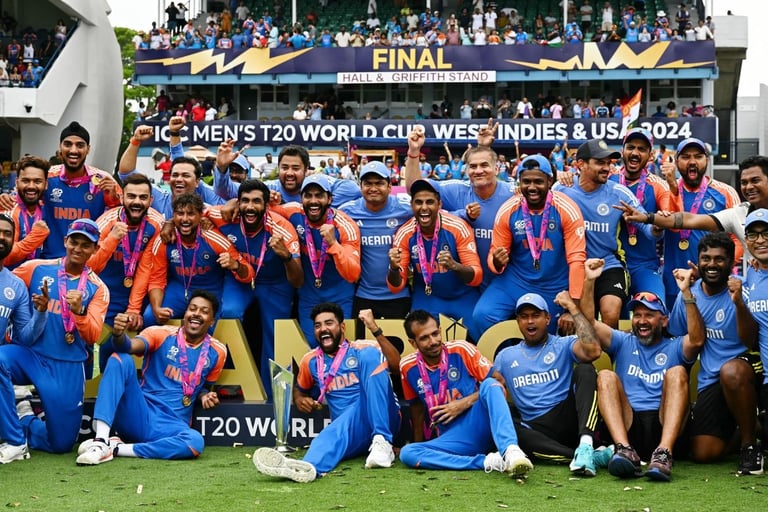
Image Credits - ICC
Prachetas Kottawar
Prachetas is a sports enthusiast from Nagpur, Maharashtra, and a passionate lover of cricket. Through his work, he strives to help viewers appreciate the game with deeper understanding and insightful analysis, aiming to decode cricket beyond surface-level perceptions and reveal the true beauty of the sport.
More from Authors
Latest Stories
© 2026 The Khel India , All Rights Reserved